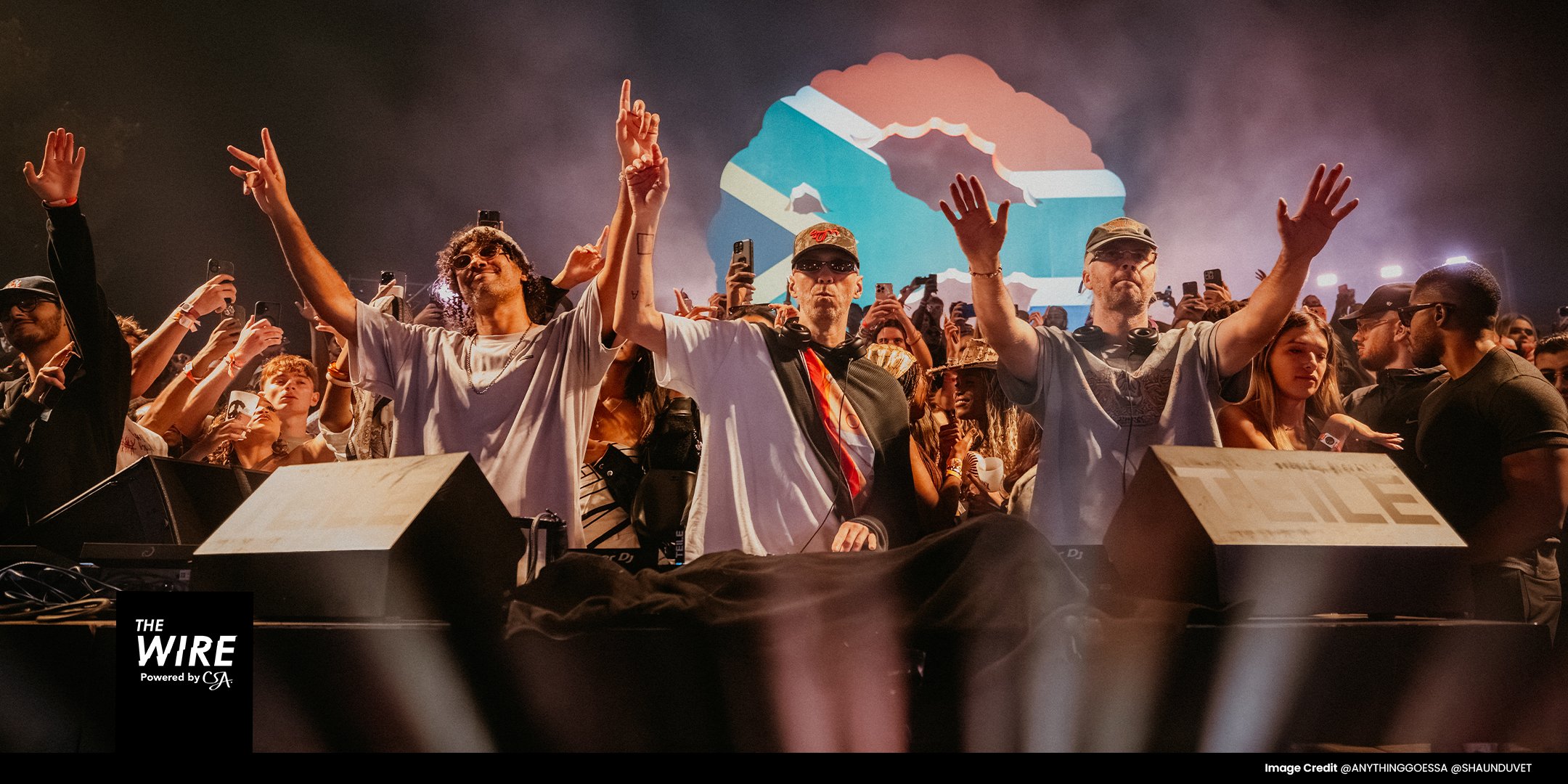
Shaun Duvet on South Africa's Dance Economy
A festival is never just a festival. For more than 25 years, Shaun Duvet has pushed South African dance music from the club to the global stage. He sits down with The Wire on the business of the dancefloor, and the economy moving to the beat.
-
100,000 festivalgoers across 33 events in a single season.
-
"Would the thing still exist if you took the logo off?"
-
Streams don't pay. The money is in live, publishing and ownership.
-
The next chapter: take South Africa to the world, with South African companies.
A festival is never just a festival. It is a city filling up, an artist breaking through, a brand earning relevance and an economy moving to the beat.
Few people understand that better than Shaun Duwe, aka Shaun Duvet.
For more than 25 years, the former DJ turned entrepreneur has helped push South African dance music beyond the club, onto global stages and into the business of culture.
He started DJing at 15. In 2003, he founded Anything Goes. Today, through The Unit, his portfolio spans festivals, touring, talent and branded experiences. But his bigger achievement is changing what a dancefloor can mean for South Africa.
The Wire spoke to him in an exclusive conversation about the South African dance economy.
From Dancefloors to Economic Powerhouses
The Wire: With Anything Goes attracting over 100,000 festivalgoers across 33 events in one season, how do you see dance culture evolving from entertainment into a serious economic driver, and what are we still undervaluing about its contribution to South Africa?
Shaun Duvet: Dance culture has been an economic driver in this country for a long time. What's changed is that the numbers are now too big to ignore.
The part we still undervalue is everything around the music. People look at a festival and see a line-up. I look at it and see security, riggers, lighting techs, sound engineers, truck drivers, bar staff, medics, caterers, cleaners, photographers and a production office that has been working for six months. Across 33 events in a season that's thousands of people earning a living, and almost none of it is counted as creative economy. It gets filed under logistics, hospitality or security, so the industry looks smaller on paper than it is.
The second thing we undervalue is skills. A lighting designer who comes up on a South African festival can work anywhere in the world, and many of them do. We are training world-class technical people and we barely talk about it.
And then there's what a show does to a city for a weekend. Hotels, restaurants, taxis, flights. Ultra alone puts hundreds of millions into the local economy and supports thousands of jobs. That's not entertainment spend, that's tourism spend with a soundtrack.
Making South Africa a Global Dance Destination
The Wire: South African dance music is influencing audiences worldwide. What will it take to turn that global cultural influence into tourism, investment and international recognition, making Johannesburg and Cape Town must-visit destinations for dance music?
Shaun Duvet: Three things, and none of them are about the music.
The first is calendar certainty. An international fan books six to nine months ahead. They need to know the date is real, the line-up is coming and the tickets are on sale. Locking and protecting the calendar is the least glamorous thing in this business and the most important.
The second is the cost and ease of getting here. We're competing with Ibiza, Tulum and Croatia, and we lose people at the flight price and the visa queue before they've even looked at a line-up.
The third is coordination. Tourism boards, airlines, hotels and promoters are all chasing the same visitor and almost never plan together. In Spain and Portugal that's a joined-up conversation. Here it's a series of separate ones.
What we have that nobody else has is the trip around the show. You can do a festival on Saturday, a wine farm on Sunday and a safari on Tuesday, and in dollars or euros it's good value.
Taking South African Talent to the World
The Wire: With global Amapiano streams growing by 114,377% between 2018 and 2024, how do we turn international demand into sustainable opportunities for local artists, and ensure South Africa benefits economically from the culture it creates?
Shaun Duvet: The honest answer is that streams don't pay. A 114,377% growth figure is a cultural signal, not a bank balance. The money sits in live performance, in publishing and in ownership, and that's where the work needs to go.
What's missing is the infrastructure around the artist. Management, publishing administration, rights registration, touring visas and basic business education. Too many South African artists have travelled the world musically and seen very little of the money, because the rights were signed away early, or were simply never registered. That's fixable and it isn't expensive to fix.
The second piece is routing. A South African artist shouldn't have to fly to Europe to play one show. We need proper regional circuits so touring is viable: Nairobi, Lagos, Maputo, Gaborone, Harare. Build the circuit and the economics of being a working artist change completely.
The third is that the companies doing the exporting should be South African. If the demand is ours and the sound is ours, the promoters, agents and production companies taking it out should be ours too. That's the part we've started on, and it's what Culture in Motion is pointed at.
Why Brands Need to Build Culture, Not Borrow It
The Wire: You've connected global brands with music culture through platforms like Corona Sunsets Festival and ULTRA South Africa. What separates brands that genuinely contribute to culture from those simply buying visibility, and why should CMOs rethink how they measure cultural investment?
Shaun Duvet: There's one test, and it's simple. Would the thing still exist if you took the logo off?
A brand that builds commits over years, gives the audience something they couldn't otherwise have, and lets the culture lead. It shows up when the show isn't selling as well as it should. It takes a view on an emerging artist before that artist is obvious. Corona Sunsets works because it's been there long enough to become a thing people plan their summer around, not a banner at somebody else's party.
A brand that borrows arrives for one activation, asks for the biggest headliner in the market, and measures impressions.
On measurement, impressions are the laziest metric we have. They tell you a logo was in frame. They tell you nothing about whether anyone felt anything or bought anything. Measure trial. Measure what people actually drank on the night, per head, against a control. Measure whether anyone can name your brand against that property a year later. Measure whether artists want to work with you again.
The CMOs who get this treat culture like a long-term asset and build equity in it. The ones who don't rent attention every year and start from zero every year.
Building a Legacy Beyond the Festival
The Wire: After more than 25 years shaping South Africa's live entertainment industry, what do you believe needs to happen next to transform our dance culture into a globally competitive creative economy, and what role should brands, government and industry leaders play in making that vision a reality?
Shaun Duvet: Three things have to move together.
Government needs to treat live events as infrastructure rather than a permitting problem. Faster, more predictable approvals, safety frameworks that are consistent from city to city, and cities that understand a festival weekend is tourism revenue, not a traffic inconvenience. We are good at safety in this country, and our people run events at a world standard. The process around them is what slows us down.
Brands need to commit beyond a season. The best cultural properties anywhere in the world took five to ten years to become what they are. Nothing gets built on a one-year deal, and the brands that keep restarting are paying more for less.
The industry needs to get its own house in order. Proper data, so we can show the economic contribution rather than assert it. Proper contracts, so artists keep what they earn. Proper training pipelines, so the technical skills we're building get recognised as careers.
And then we export. For over two decades we've brought the world to South Africa. The next chapter is taking South Africa to the world, and doing it with South African companies, South African crews and South African artists keeping the value here.
Quick Fire
The Wire: What music are you listening to right now?
Shaun Duvet: I listen to a lot of music, and it depends on the mood. I can find myself moving between Neil Young and Bob Dylan all the way through to Pawsa, The Prodigy, Fred Again.., Four Tet and Maribou State.
The Wire: Where's your favourite place to recharge?
Shaun Duvet: I love a good mountain walk. I live in Cape Town and there's truly nothing more magical than being up in the mountains with my family and the dog.