
- Drives up to 65% higher engagement and 5–15% revenue uplift
- Increases ad recall and memory retention through multi-sensory interaction
- Generates real-time behavioural intelligence across touchpoints
- Enables personalisation at scale, in the moments that matter
- Participation is now the currency of culture
Marketing isn’t just at risk of losing attention, it’s increasingly about participation.
Audiences no longer want to be targeted, they expect to be involved, shaping and stepping inside the experiences brands create. If they’re not, they move on.
That’s the shift. It’s why the most effective brands today aren’t just showing up in culture, they’re engineering it in real time.
Welcome to the era of phygital. Not as a tactic, but as a system.
Participation Is the New Currency of Culture
Culture marketing has moved beyond just storytelling. Today, it’s about building environments where people don’t just consume, they contribute.
“Phygital”, the fusion of physical and digital, removes friction between touchpoints, blending real-world presence with digital immersion to create experiences that linger. It’s where brands move from being seen to being felt, and where audiences shift from passive observers to active participants.
The impact is tangible. Phygital ecosystems are driving significantly higher engagement, increasing revenue, and generating real-time behavioural intelligence that allows brands to personalise at scale.
This Isn’t Technology. It’s Behavioural Infrastructure.
Phygital is often reduced to the tools that power it, QR codes, AR layers, and interactive screens. But that’s only the surface.
At its core, phygital connects environments, captures intent, and creates a continuous dialogue between physical and digital worlds. Whether it’s scanning a product in-store to unlock deeper content or interacting with environments that adapt in real time, the experience becomes fluid, intuitive and personalised.
From Campaigns to Cultural Systems
The brands winning in this space aren’t running campaigns. They’re building systems people can step into. Nike has transformed retail into a space of co-creation, where customers help design products — turning ownership into participation.
Ferrari has reimagined the showroom as immersive theatre, overlaying digital experiences onto physical environments to deepen emotional connection and storytelling.
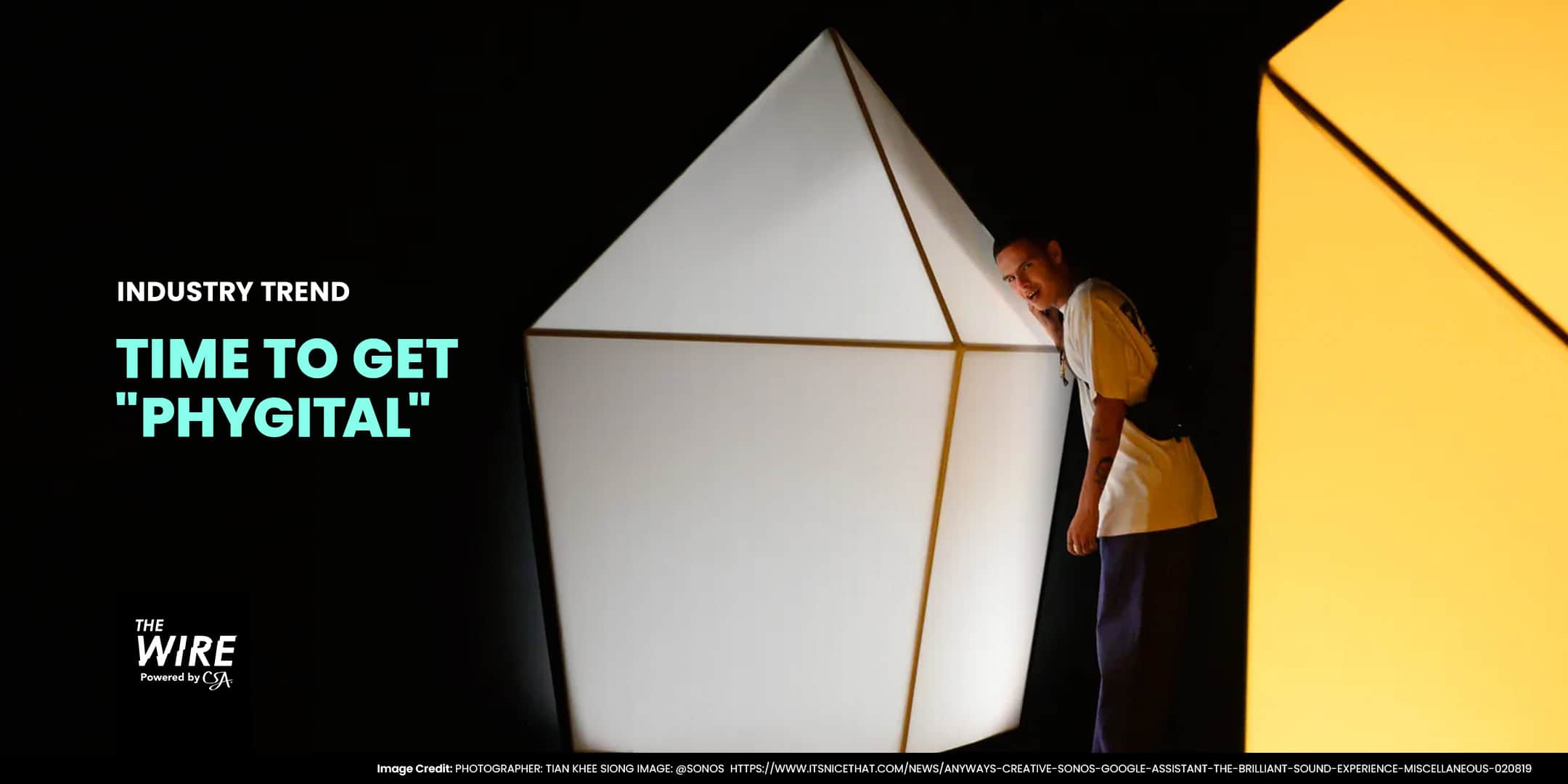
Sonos has embedded itself within music culture through environments that merge sound, space and interaction, capturing both attention and behavioural data.
Closer to home, early signals are emerging through hybrid cultural formats where physical presence and digital extension operate as one.
What unites these examples is simple: people are no longer just attending, they are participating.
How to Build Phygital That Actually Works
Phygital isn’t something you layer onto an existing campaign; it requires rethinking the experience from the ground up. It begins by identifying the moments where audiences move between physical and digital environments, retail, events, mobile and social, where attention peaks and behaviour can be shaped most effectively.
From there, technology must be applied with intent. Tools like augmented reality or connected devices should deepen immersion rather than distract from it. The goal is seamless enhancement, not digital noise. Every interaction becomes a source of intelligence, revealing how people behave and enabling experiences to evolve in real time through continuous feedback loops.
Most importantly, these systems must be designed for participation. When audiences are invited to co-create and influence outcomes, engagement compounds. And unlike traditional campaigns, phygital doesn’t end at launch, it evolves through live insights as people engage with it.
Measuring What Actually Matters
In a phygital world, success cannot be measured by reach alone. The real indicators sit deeper, in how people respond, remember and advocate. It’s about the quality of engagement, the strength of recall, and how behaviour shifts across touch points.
When measured properly, these signals reveal something far more valuable than attention: it’s how experiences translate into loyalty and lasting connection.
The Bottom Line
Phygital isn’t a trend. It’s a response to a fundamental shift in how people engage with brands.
The question is no longer how you reach your audience, it’s whether they can step into what you’ve created. Because the brands that win won’t be the ones people simply see.
They’ll be the ones people feel part of.